
Quick Response Code, which is also known as “QR Code”, is a two-dimensional version of the barcode, it was created in 1994 by Denso Wave, a Toyota subsidiary to quickly track automobiles. Then, it was developed for process in the logistics of the automotive industry to be more effective, and eventually the code has created its way into mobile marketing with the extensive adoption of smartphones (Turner, 2018).
Nowadays, QR codes are more common than ever and they are more likely to be used to access to Wi-Fi networks and websites, sharing contact or address information, making payments and getting data for train and air tickets. Most importantly, QR codes have advantages over the conventional barcodes as they have bigger data capacity and great fault tolerance (Turner, 2018). In addition, QR codes are available for everyone to use and they are very simple, but how simple they are?
How do QR codes work?
Basically, QR codes work the same way as barcodes at the supermarkets. They are “machine-scannable image” that can immediately be read by just using Smartphone camera. When they are scanned, the application will translate the black squares and dots that QR code consists into the information that can be read and understood. In 2017 for instance, Apple iOS 11 update allows users to be able to scan QR codes directly through the camera app. All we need to do is to open the Camera App, hold the device and QR code appears in the viewfinder, then we can see notification with a link, click it and we will see the information associate with the QR code (Ratna, 2020).
Due to its high abilities that allows people to access to everything or any information quickly and more convenient, QR code have a huge impact on mobile marketing and many businesses enjoy using it as a tool to bridge the gap between the physical and the digital worlds.
Why is it important and relevant?
Although QR codes works almost the same way as barcode, QR codes are able to store more data up to 406 bytes of data (Fram, 2018). As it could store as much data together with the quick access to information, it creates opportunities to engage uses in a positive way such as:
- Increasing customers’ awareness as majority of social media platforms including Facebook, Instagram, WhatsApp and Snapchat integrate QR codes and scanners, it makes users be able to follow accounts easily by scanning the codes.
- Allowing shopper to have a unique experience. Nike’s Flagship store uses QR codes throughout the entire store. They have ‘Scan to Try” where the members can scan and get store assistants. Additionally, Nike designed Nike Instant Checkout which uses QR codes to let their customers to avoid queuing for a long checkout from the Nike app (Ratna, 2020).
- QR codes have been used by many hospital to store the patients’ information. With a scan, the doctors or nurse will get their patients’ data such as medication prescription.
How is it structured? What is with all the squares?
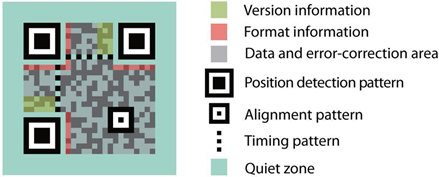
These are 7 structures of QR codes: (QR Code Generator, 2020)
- Version information: These numbers range from 6 to 40. A version below 6 does not require the scanner to have it defined as the scanner can identify the version just from other individual areas of the QR code.
- Format information: contains the types of information that will be encoded such as a website URL, SMS message, vCard information, alphanumeric, and numeric.
- Data and error-correction area: This area contains patterns that hold key data/information.
- Positioning detection pattern: The three squares in the top and bottom left and right corners of the QR code that is used to tell scanner of the direction that the code is printed.
- Alignment markings: The square on the bottom right is there to further ensure the alignment accuracy of the QR code.
- Timing pattern: Allows the scanner to define how large the data area is and to tell the scanner the placements of columns and rows of black and white dots.
- Quiet zone: The space around the QR code is important for the scanner to the QR Code from its surroundings.
References:
Ratna, S. (2020). Why 2020 is the Year of QR Codes. Retrieved from Beaconstac: https://blog.beaconstac.com/2019/02/why-2019-is-the-year-of-qr-codes/
Turner, M. (2018). QR Codes Explained. Retrieved from Techspot: https://www.techspot.com/guides/1676-qr-code-explained/
QR Code Generator (2020). QR Code Basic. Retrieved from QR Code Generator: https://www.qr-code-generator.com/qr-code-marketing/qr-codes-basics/
 Phouk Sokchheng's MIS304